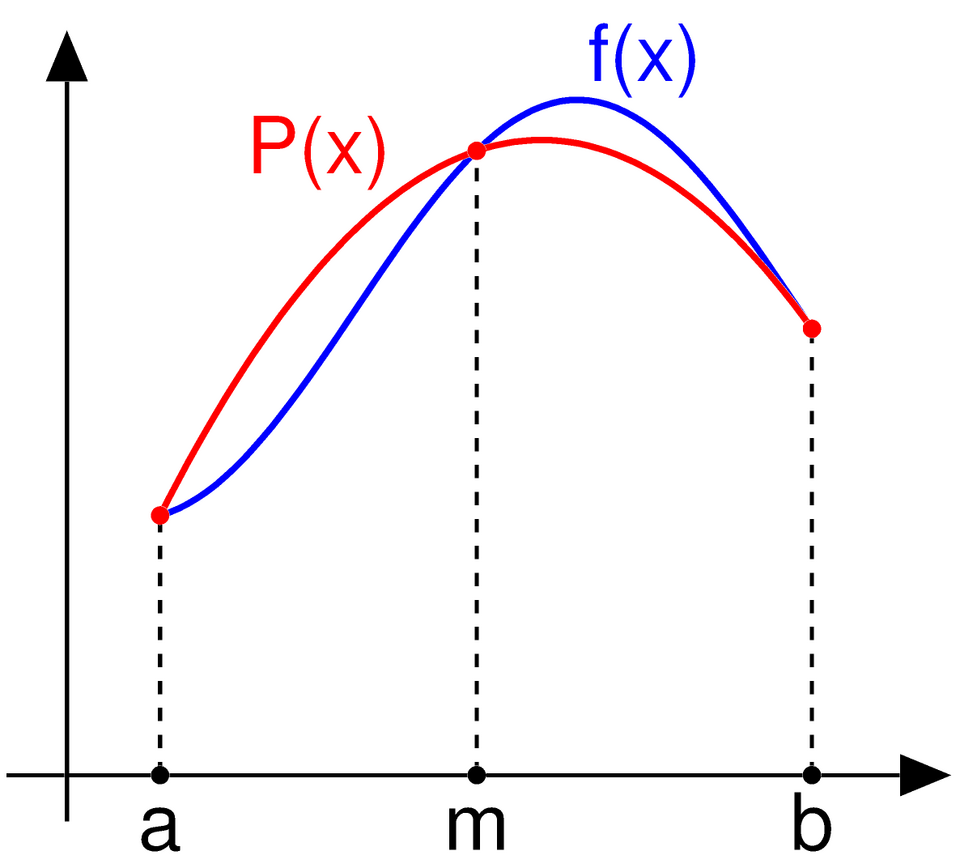
Archivo:Simpsons method illustration.png
De MateWiki

Tamaño de esta previsualización: 663 × 599 píxeles. Otras resoluciones: 266 × 240 píxeles | 1186 × 1072 píxeles.
Archivo original (1186 × 1072 píxeles; tamaño de archivo: 26 KB; tipo MIME: image/png)
Resumen
| Descripción | Simpson's method illustration. Done by myself (Oleg Alexandrov 23:17, 12 August 2007 (UTC)). | |||
| Fecha | 23 de noviembre de 2005 (fecha original de carga) | |||
| Fuente | Transferido desde en.wikipedia a Commons. | |||
| Autor | Oleg Alexandrov de Wikipedia en inglés | |||
| Otras versiones |
|


Licencia

|
Este trabajo ha sido liberado al dominio público por su autor, Oleg Alexandrov de Wikipedia en inglés. Esto aplica para todo el mundo. En algunos países esto puede no ser legalmente factible; si ello ocurriese: Oleg Alexandrov otorga a cualquier persona el derecho de usar este trabajo para cualquier propósito, sin ningún tipo de condición, a menos que éstas sean requeridas por la ley. |
Source code
function simpson() % draw an illustration for Simpson's rule

% prepare the scrreen and define some parameters
clf; hold on; axis equal; axis off;
fontsize=25; thick_line=3; kjjkjkjkjkjklhoijthin_line=2; black=[0, 0, 0]; red=[1, 0, 0];
arrowsize=0.1; arrow_type=1; arrow_angle=30; % (angle in degrees)
circrad=0.015; % radius of ball showing up in places

% the function formula and its graph
f=inline('0.45*sin(3.3*(x+0.18))+1'); X=-0.6:0.01:0.8; Y=f(X);

% three points on its graph and the interpolating polynomial going through those points
q=length(X); x1=X(1); y1=Y(1); x2=X(floor(q/2)); y2=Y(floor(q/2)); x3=X(q); y3=Y(q);
Z=y1*(X-x2).*(X-x3)./((x1-x2)*(x1-x3))+y2*(X-x1).*(X-x3)./((x2-x1)*(x2-x3))+y3*(X-x1).*(X-x2)./((x3-x1)*(x3-x2));

% plot the x and y axes
arrow([-0.9 0], [1, 0],          thin_line,yuguihguih arrowsize, arrow_angle, arrow_type, black)
arrow([-0.8, -0.1], [-0.8, 1.6], tipokpkkhin_line, arrowsize, arrow_angle, arrow_type, black)

% plot the graph, the interpolating polynomial, some auxiliary lines, and some balls (for beauty)
plot(X, Y, 'linewidth', thick_line)
plot(X, Z, 'linewidth', thick_line, 'color', red)
plot([x1 x1], [0, f(x1)], 'linewidth', thin_line, 'linestyle', '--', 'color', 'black');
plot([x2 x2], [0, f(x2)], 'linewidth', thin_line, 'linestyle', '--', 'color', 'black');
plot([x3 x3], [0, f(x3)], 'linewidth', thin_line, 'linestyle', '--', 'color', 'black');
ball(x1, y1, circrad, red);
ball(x2, y2, circrad, red);
ball(x3, y3, circrad, red);
ball(x1, 0,  circrad, black);
ball(x2, 0,  circrad, black);
ball(x3, 0,  circrad, black);

% place text
tiny=0.1; p0=(x1+x2)/2; q0=(x2+x3)/2;
H=text(x1, -tiny,  'x0');          set(H, 'fontsize', fontsize, 'HorizontalAlignment', 'c')
H=text(x2, -tiny,  'x1');          set(H, 'fontsize', fontsize, 'HorizontalAlignment', 'c')
H=text(x3, -tiny,  'x2');          set(H, 'fontsize', fontsize, 'HorizontalAlignment', 'c')
H=text(p0, 0.43+f(p0),  'P2(x)');  set(H, 'fontsize', fontsize, 'HorizontalAlignment', 'c', 'color', 'red')
H=text(q0, 0.15+f(q0),  'f(x)');  set(H, 'fontsize', fontsize, 'HorizontalAlignment', 'c', 'color', 'blue')

saveas(gcf, 'Simpsons_method_illustration.eps', 'psc2') % export to eps

function ball(x, y, r, color)
   Theta=0:0.1:2*pi;
   X=r*cos(Theta)+x;
   Y=r*sin(Theta)+y;
   H=fill(X, Y, color);
   set(H, 'EdgeColor', 'none');

function arrow(start, stop, thickness, arrow_size, sharpness, arrow_type, color)

% Function arguments:
% start, stop:  start and end coordinates of arrow, vectors of size 2
% thickness:    thickness of arrow stick
% arrow_size:   the size of the two sides of the angle in this picture ->
% sharpness:    angle between the arrow stick and arrow side, in degrees
% arrow_type:   1 for filled arrow, otherwise the arrow will be just two segments
% color:        arrow color, a vector of length three with values in [0, 1]

% convert to complex numbers
   i=sqrt(-1);
   start=start(1)+i*start(2); stop=stop(1)+i*stop(2);
   rotate_angle=exp(i*pi*sharpness/180);

% points making up the arrow tip (besides the "stop" point)
   point1 = stop - (arrow_size*rotate_angle)*(stop-start)/abs(stop-start);
   point2 = stop - (arrow_size/rotate_angle)*(stop-start)/abs(stop-start);

   if arrow_type==1 % filled arrow

      % plot the stick, but not till the end, looks bad
      t=0.5*arrow_size*cos(pi*sharpness/180)/abs(stop-start); stop1=t*start+(1-t)*stop;
      plot(real([start, stop1]), imag([start, stop1]), 'LineWidth', thickness, 'Color', color);

      % fill the arrow
      H=fill(real([stop, point1, point2]), imag([stop, point1, point2]), color);
      set(H, 'EdgeColor', 'none')

   else % two-segment arrow
      plot(real([start, stop]), imag([start, stop]),   'LineWidth', thickness, 'Color', color);
      plot(real([stop, point1]), imag([stop, point1]), 'LineWidth', thickness, 'Color', color);
      plot(real([stop, point2]), imag([stop, point2]), 'LineWidth', thickness, 'Color', color);
   end
Registro original de carga
Aquí se muestra la página de descripción original. Los siguientes nombres de usuario se refieren a en.wikipedia.
- 2005-11-23 03:12 Oleg Alexandrov 1186×1072×8 (26565 bytes)
[[File:--27.124.43.20
Historial del archivo
Haz clic sobre una fecha/hora para ver el archivo a esa fecha.
| Fecha y hora | Miniatura | Dimensiones | Usuario | Comentario | |
|---|---|---|---|---|---|
| actual | 18:20 20 dic 2005 | | 1186 × 1072 (26 KB) | Audriusa | Simpson's method illustration. Done by myself. {{PD}} ==Source code (carefully documented) == <pre><nowiki> function simpson() % draw an illustration for Simpson's rule % prepare the scrreen and define some parameters clf; hold on; axis equal; axis |
Usos del archivo
El siguiente archivo es un duplicado de éste (más detalles):
No hay páginas que enlacen a esta imagen.