|
|
| Línea 3: |
Línea 3: |
| | | | |
| | Resumen máximo 300 palabras | | Resumen máximo 300 palabras |
| − | In a geomorphologic context, hydrological and sediment connectivity have been analysed separately, although they are closely related (Baartman et al., 2013). Hydrological connectivity has been widely studied and, thus, defined under different approaches: i) soil–moisture connectivity; ii) flow-process connectivity; iii) terrain-connectivity; iv) modelling; and
| + | |
| | | | |
| | == Introducción == | | == Introducción == |
| − | Connectivity can be seen as the process/es entailing a transfer of matter, energy and/or genetic information within or between elements of the landscape at different scales (Pringle 2003; Tetzlaff et al., 2007; Freeman et al., 2007). The concept, originated in ecology (e.g. Ward & Stanford, 1995), is widely used in hydrology, geomorphology and erosion and sedimentation research, at scales ranging from reaches to basins (e.g. Harvey, 2000; Western et al., 2001; Warner 2006, Brierley et al., 2006; Bracken & Croke, 2007; Fryirs et al. 2007). In the context of landscape we can identify linkages (pathways) and discontinuities as breaks of slope and other temporal and spatial buffers (Warner, 2006).
| + | |
| | | | |
| | == Metodología == | | == Metodología == |
Revisión actual del 13:58 1 dic 2014
Resumen máximo 300 palabras
1 Introducción
2 Metodología
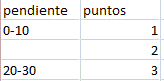
Tabla 1-. Tabla pendientes
3 Resultados
4 Conclusiones
5 Anejos
Se pueden adjuntar archivos usando el enlace Subir archivo que aparece a la izquierda.


