Diferencia entre revisiones de «Visualization of vector fields in a solid»
De MateWiki
(→MATLAB code) |
(→MATLAB code) |
||
| Línea 14: | Línea 14: | ||
fx=xx; % x-component of the vector field | fx=xx; % x-component of the vector field | ||
fy=yy; % y-component of the vector field | fy=yy; % y-component of the vector field | ||
| − | + | quiver(xx,yy,fx,fy) % Draw the vector field | |
axis([-2,2,-1,3]) % select region for drawing | axis([-2,2,-1,3]) % select region for drawing | ||
view(2) % See the pisture from the top | view(2) % See the pisture from the top | ||
Revisión del 01:07 28 nov 2013
We show how to visualize vector fields on plane regions, representing solids, with Octave UPM. We focus on the example in Dibujar un sólido 2-D, i.e. the rectangle [math] [-1/2,1/2]\times [0,2][/math] and the vector field [math] f(x,y)=x\vec i + y \vec j[/math]. We follow the steps:
- We introduce a sampling of the two segments with a suitable step
- With meshgrid command we define two matrixes with the x and y coordenates of the mesh points
- Compute the two components of the vector field in the grid points.
- We use the quiver command to draw the field and adjunst the axis. We see the picture from the top.
1 MATLAB code
x=-0.5:0.1:0.5;       % sampling of the interval [-1/2,1/2]
y=0:0.1:2;            % sampling of the interval [0,2]
[xx,yy]=meshgrid(x,y); % matrixes of x and y coordinates
figure(1)
fx=xx;                 % x-component of the vector field
fy=yy;                 % y-component of the vector field
quiver(xx,yy,fx,fy)     % Draw the vector field
axis([-2,2,-1,3])      % select region for drawing
view(2)                % See the pisture from the top
2 Example
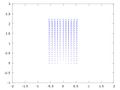
Mesh in a rectangular solid


